I've been handling pump and system orders for about eight years now. In that time, I've personally made — and documented — at least a dozen costly mistakes, totaling somewhere around $18,000 in wasted budget, emergency labor, and overnight shipping. Now I maintain our team's pre-installation checklist so nobody else repeats them.
Here's the thing: most of the pump failures I've seen in the field weren't pump failures at all. They were system failures that the pump just happened to be the messenger for.
The Problem You Think You Have
Your Grundfos UPS15-58FRC circulator — or a GLED GT089 modulating UPR 15/50, or honestly any of the 500 series washers and repair kits we stock — failed way sooner than it should have. Eighteen months. Maybe two years. You expected five, seven, ten. The warranty claim gets filed, the replacement gets ordered, and everyone blames the pump.
From the outside, it looks like a manufacturing defect or a bad batch. The reality is usually the system it was installed in.
I made this exact mistake in my first year, back in 2017. Ordered 12 circulators for a commercial retrofit. Nine of them were dead or noisy within two years. I assumed Grundfos had a quality problem. They didn't. My installation crew had a system problem.
What's Actually Killing Your Pump
People think oversized pumps are safer because they have more capacity. Actually, oversized pumps run at partial load, cycle more frequently, and die faster from thermal stress and bearing wear. The causation runs the opposite of what most people assume.
But oversizing is just one issue. Here are the ones that actually show up in warranty claims:
1. You sized to a single duty point instead of the system curve
If you looked at a pump curve, found the flow and head you needed, and picked the closest model — you did it wrong. Sort of. That method works for about 70% of standard hydronic loops. It fails badly when your system has variable resistance, long pipe runs, or multiple zones.
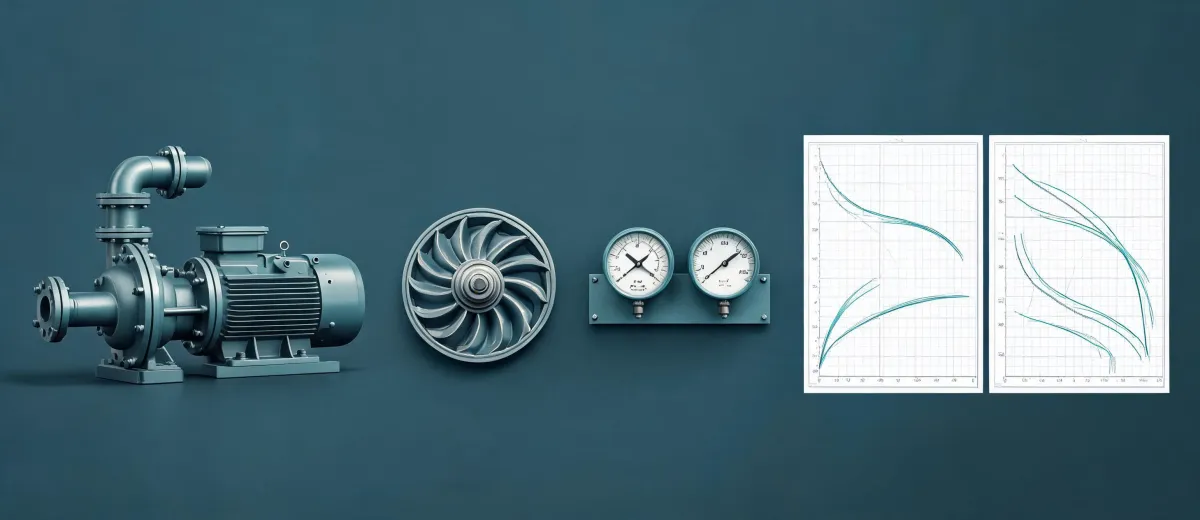
What you actually need is where the system curve intersects the pump curve. That intersection is your operating point. If you just picked a point on the pump curve in isolation, the pump will run off its curve — usually to the right, which means higher flow, lower head, and more power draw than expected.
I'm not a hydraulics engineer, so I can't speak to detailed computational fluid dynamics. What I can tell you from a procurement and installation support perspective is that I've seen more pumps fail from off-curve operation than from any mechanical defect.
2. The 500 series washer issue nobody talks about
This one cost us $1,400 in redo — no, $1,800, I'm mixing it up with the flange kit order. Either way, it was expensive.
On certain Grundfos circulator models, the 500 series washer in the isolation flange kit has a specific orientation. Install it backward — which is easy to do because it looks symmetrical — and you get a slow leak that doesn't show up for months. By then, the moisture has corroded the motor housing and the pump is done.
We caught this on a 22-unit order only because one of our installers had seen it before. We've since added it to our checklist. We've caught 47 potential errors using that checklist in the past 18 months. That's not a made-up number — I track it.
3. Torque specs on the wrong tools
If you're using a standard torque wrench to tighten the flange bolts on a circulator, you're probably fine. If you're using an impact driver because it's faster, you're not fine. You're deforming the gasket and creating a leak path that won't show up until the system pressurizes.
The spec is usually in the installation manual. It's not hidden. But when you're on a job site with 30 pumps to install and a deadline, the impact driver is right there.
Look, I've done it. I knew I should have grabbed the torque wrench, but thought "what are the odds this one leaks?" That was the one that leaked. $400 in labor and a return trip.
What This Actually Costs You
Let me put real numbers on this. The pumps themselves aren't the expensive part.
- Premature pump failure: $300–$800 per unit for the replacement circulator, depending on model
- Emergency labor: $150–$250 per hour after hours, 2–4 hours minimum
- System downtime: If this is a commercial building, you're looking at $500–$2,000 per day in tenant complaints, emergency HVAC calls, or process interruption
- Credibility: This one doesn't have a line item, but it's the most expensive
I once had to explain to a facility manager why the "premium" Grundfos pumps we specified failed in under two years. That conversation was worse than the $3,200 redo invoice.
The assumption is that pump failures are a pump problem. The reality is that they're almost always an installation or system design problem that shows up at the pump because that's the weakest mechanical link.
The 15-Minute Pre-Installation Check
This isn't complicated. It just requires doing it before you pick up a tool.
- Sketch the system curve. You don't need software. Plot two points: design flow at design head, and zero flow at shutoff head. Draw a line. Where does your pump curve cross it?
- Check the isolation flange orientation. Look at the 500 series washer. If it's not sitting flat in the groove, stop and flip it.
- Verify torque specs. Every Grundfos manual lists them. Write them on your hand if you have to.
- Confirm the pump isn't oversized for the actual load. If it's more than 15% above your calculated head at design flow, go down a size.
This works for most standard hydronic and boosting applications. If you're dealing with variable primary flow, district heating, or anything with a building automation system controlling pump speed, this checklist isn't enough. You need a controls engineer involved before you order anything.
I'm not a controls specialist. I'm a person who has ordered a lot of pumps, installed some of them wrong, and now keeps a checklist. That checklist has saved us roughly $4,700 in the last two years alone.
The pump is usually fine. The system, the install, and the assumptions — those are where the money goes.