Most "pump failures" I get called out to fix aren't failures at all. They're selection mistakes. I've been handling pump selection and installation work for commercial buildings since 2017, and I've personally made eleven documented mistakes—the kind that cost money and credibility—totaling roughly $9,800 in wasted budget. I now maintain our team's pre-purchase checklist so nobody else repeats my errors.
So here's my position, and I'm not softening it: The pump industry doesn't have an equipment reliability problem. It has a selection and process problem. Most of the "bad pumps" people swear at were never bad. They were wrong for the job. And in my experience, that's true more than half the time.
Almost Everyone Skips the Pump Curves
Start with the mistake I see most often: people treat the pump curve like fine print you can ignore.
First year in the trade. I was specifying a replacement for a submersible in a small apartment complex. Existing unit was a Grundfos, and my instinct was simple: match the horsepower, match the discharge size, call it a day. That's what the guy before me did too, apparently.
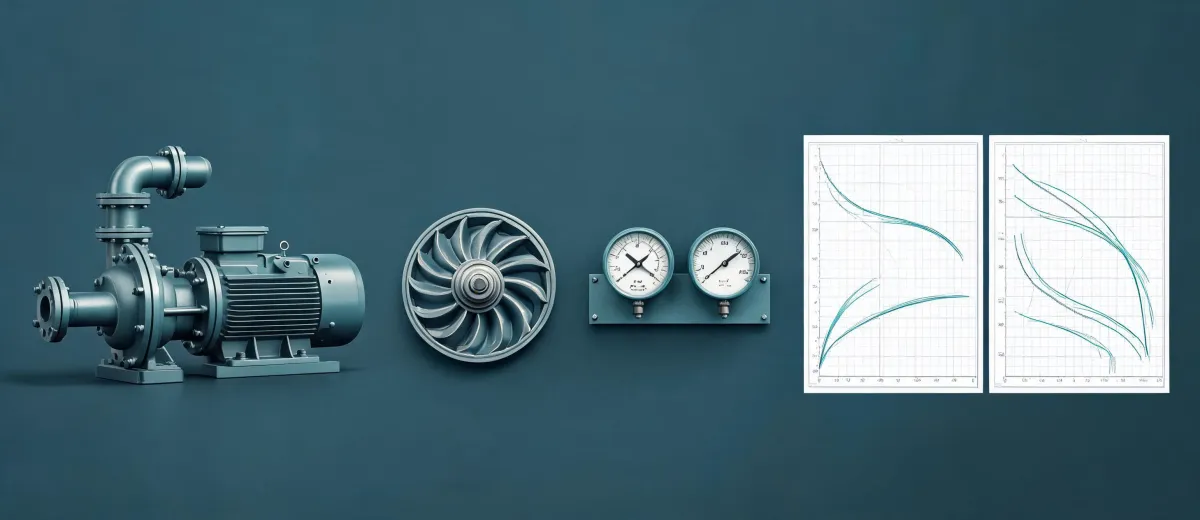
The Grundfos SQE pump curves tell a different story if you actually sit down with them. The SQE series is a variable-speed submersible with a wide operating range. Two pumps with identical motor ratings can have completely different performance depending on impeller selection and the specific curve family. I ordered the replacement based on horsepower. It pumped less water than the old unit at the same head—because the curve was different. Tenants complained for three days before I figured out what I'd done. Rework plus the new pump? About $1,100 wasted, plus a weekend I'll never get back.
The thing nobody tells you on the job site: the curve isn't documentation. It's the spec. The model number tells you what's in the box. The curve tells you what it'll do in your system. Those are different things, and the difference costs real money. Pump performance testing itself follows ISO 9906, which defines how curves are measured and what tolerances apply. Even a Grade 2 test tolerance can mean a few percentage points of variance. That doesn't sound like much until you size a pump right at the edge of its range and it comes up short.
Now I have a rule in our checklist: before any submersible or circulator gets ordered, someone has to pull the Grundfos curves, confirm the duty point falls inside the recommended operating window, and initial the work order. (Note to self: rule exists because I skipped it once. Don't skip it again.) Sounds bureaucratic. But it's caught problems on roughly 15 of the last 50 orders we've processed. That's 30%, and most of those would have become another "mystery" failure in the field.
Why does this matter? Because the gap between "works on paper" and "works in the ground" is where the industry loses its reputation.
The Wastewater Technology Misunderstanding
Here's a question that used to embarrass me: what's the difference between a sewage pump and a wastewater pump? I'd been installing both for years and honestly could not explain it clearly.
Grundfos wastewater pump technology isn't just a phrase for marketing brochures. It refers to concrete design choices: solids handling capability, vortex or super-vortex impellers, free passage diameter, and how the hydraulic end manages stringy material without clogging. I ignored all of that on a job in September 2022.
I installed a standard sewage pump in a lift station with unpredictable influent—rags, wipes, what looked like a fishing net at one point. It clogged three times in six weeks. The client called me every time. On the third visit, I finally pulled the submersible pump catalogue and looked for a wastewater-specific model with the correct free passage and impeller type. The replacement has run for 14 months without a single clog.
It's tempting to think "a pump is a pump." It's not. The technology differences between pump lines determine exactly whether you get a callback in pride or in shame. And here's the kicker: I knew about wastewater impeller options. I just didn't think this application needed them. That was the mistake—not my knowledge, but my judgment.
The "just get the cheapest one that fits" advice ignores free passage specs, solids size, and actual influent composition. Those variables make or break a wastewater installation.
Tools Are Part of the Process, Not an Afterthought
Efficiency isn't only about which pump you order. It's also about how fast and how correctly you install it. I've learned that having the right tools on the truck is a cost issue, not a comfort issue.
Example one: the adjustable wrench. What is the adjustable wrench used for, really? It's a fallback tool—for odd-sized fasteners, for a quick grip, for when that brass nut is slightly off-standard and you didn't bring the full satchel. The mistake I made for years? Using it as a primary tool to save time. Then I rounded a fitting on a pressure tank in a customer's basement. The proper wrench was 40 feet away in the truck. The adjustability cost me a callback and a new fitting.
Example two: fasteners. The Duraspin collated deck screw 08d200w isn't glamorous, but it saves real minutes on every job. Collated screws feed continuously from a strip, so there's no fumbling with individual screws when you're on a ladder or in a cramped pump pit. The 08d200w designation—#8 diameter, 2 inches long—is my standard for mounting pump bases and access platforms. It trims maybe 20 to 25 minutes off a typical installation. Multiply that out over a month of callouts and it's not trivia—it's the difference between finishing at 4 PM or 6 PM.
This was true ten years ago too. But the reluctance we see today isn't about availability. It's about habit. People keep reaching for what they grabbed in 2015.
Objection: "But I've Always Done It This Way"
I hear the pushback. "The local distributor doesn't stock the right model." "I don't have time to study pump curves on every job." "My adjustable wrench has served me fine for 20 years."
I'm not going to respond with "everyone's situation is different," because I don't believe it.
The "local distributor is easier" thinking comes from an era before modern logistics and online catalogues. A decent supplier can get the correct submersible pump to the job site in two days. The real cost isn't those two days—it's the unquantified time you lose to a wrong-sized pump that runs but doesn't deliver.
Here's what finally convinced me—my own reverse lesson. Everyone told me to check specifications before every single order. I skipped that step once, on a routine-looking replacement, and it cost me $1,100. I do not need a second lesson of that kind.
Efficiency Is the Competitive Advantage
So my position is firm: efficiency is the industry's real competitive edge. Not cheaper pumps. Not "we'll beat any quote." Process discipline—selecting from the complete range, using the curves properly, having your tools sorted, doing it right the first time.
I've seen the numbers on my side. When I started using the submersible pump catalogue to verify every selection, warranty callbacks dropped. When our team standardized installation tools, callouts got shorter. We quote about 15% faster on service work now because we stopped second-guessing our own selections. That's not magic. It's just not repeating the same mistakes.
What I want you to take away is simple: the most expensive pump you can buy is the wrong one—at any price. The cheapest fix is a little more process discipline upstream. I don't say that as a sales pitch. I say it as someone who paid the tuition.