There's a common assumption that a good purchasing manager knows every product category cold. That's not true. I'm an office administrator for a 250-person company, and since 2018 I've placed orders for everything from office chairs to sump pumps. When I first started handling the maintenance orders, I tried to find a single 'best' pump, a 'best' tool set, and a 'best' air compressor. I learned the hard way: there is no universal best. It comes down to your specific situation. So here's my buyer's guide, built around the scenarios I actually run into.
Scenario A: Circulation problems with heat or hot water
First winter in this job, the east wing of our office wouldn't warm up. Our maintenance guy kept saying there was air in the lines. We bled radiators twice, no luck. Turned out the real issue was a missing thermal bypass valve. Basically, a bypass valve lets a small amount of water keep flowing through the heating loop even when the zone valve is closed. That small flow prevents the pump from dead-heading, which stops water hammer and keeps the system balanced. A Grundfos thermal bypass valve is the one our HVAC contractor has recommended more than once—it's dependable and easy to install.
But before you buy any valve or pump, you need a sanity check on flow rate. The simplified formula for a centrifugal pump is Q = A × v, where A is the cross-sectional area of the pipe and v is the fluid velocity. Say you have a 1-inch pipe (inner radius about 0.013 meters) and you want a flow velocity of 2 m/s. The area is roughly 0.00053 m², so Q is about 0.0011 m³/s—which is around 17 GPM. That tells you whether the pump you're looking at is even in the right ballpark.
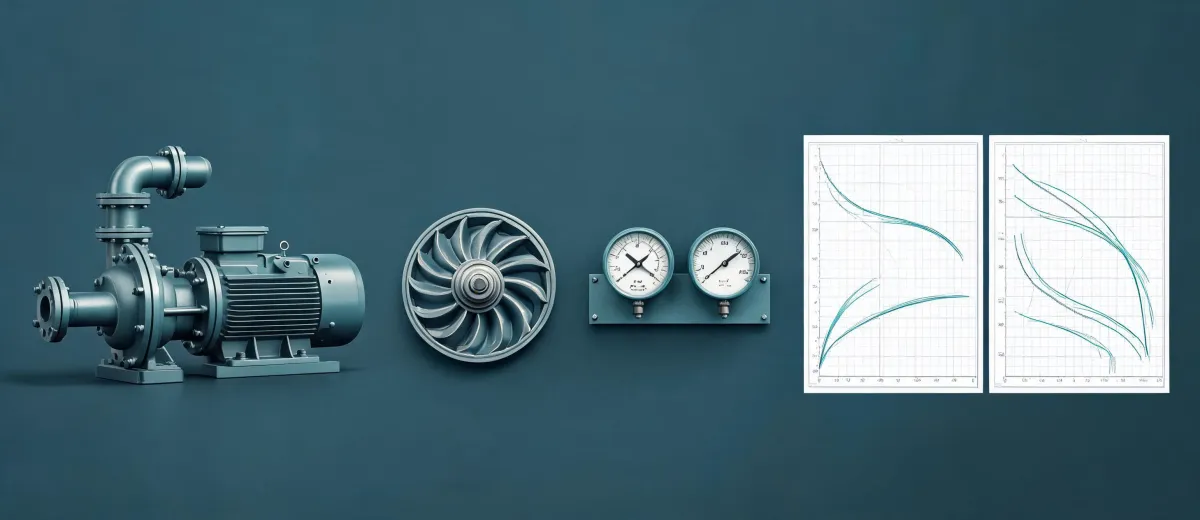
Now, I'm not a mechanical engineer, so this gets into hydraulics territory where I only go far enough to make smart purchasing decisions. For complex systems, I pull the Grundfos pump curve—they publish detailed performance data, tested to ISO 9906—and I verify the number against the curve before spending any money. The flow formula is a starting point, not the whole story.
Scenario B: Standing water, sump pits, and sewage lifts
When you're dealing with a flooded basement or a sewer ejector, you need a submersible water pump. This is a completely different decision process. The first big mistake I see from other buyers? Rushing to horsepower. I almost bought a 0.5 HP Grundfos submersible water pump because it looked powerful enough. The contractor stopped me, and he was right: what actually matters is total dynamic head—the vertical lift plus friction losses from the pipe run.
Here's how I approach it now. Measure the vertical distance from the bottom of the pit to the highest point in the discharge pipe. Then add friction losses for the horizontal run and fittings. If your pit is 3 meters deep and the line runs 20 meters horizontally, you're not pumping against just 3 meters. You need to see the pump curve and find the flow rate at that combined head. The question everyone asks is 'how many horsepower?' The question they should ask is 'what's the flow at my actual head?'
I don't have hard data on failure rates across brands, but looking back at the systems I've bought, the only pumps that failed were undersized. We upsized our latest selection by about 20% above the calculated head, and it's been quiet and reliable ever since. Spending a few hundred dollars more on sizing saved us several thousand in emergency service calls.
Scenario C: Equipping the maintenance shop
If you're reading 243-piece mechanics tool set reviews, take my advice: ignore the piece count for a minute and look at the sockets. Does it include both SAE and metric, and the common drive sizes (1/4, 3/8, 1/2)? Are there obscure but useful sizes like 5.5mm? And check the case quality. We bought a budget set that developed a cracked latch within a month—that alone turned a bargain into a hassle. I'd rather buy a mid-range set with a lifetime warranty than a no-name one that costs 40% less.
And when you're hunting for shop deals on air compressor, don't buy based on peak PSI. Look at the CFM at 90 PSI—that's what your nail guns and impact wrenches actually need. Also check whether the deal includes hoses and fittings. I once saw a great-looking price that didn't include those, and by the time I added the necessary pieces, it was no better than buying a complete unit.
So glad I checked the reviews for our compressor before pulling the trigger. Almost ordered one that would have been fine for inflation but useless for air tools. Honestly, a compressor's duty cycle matters as much as its max pressure. If your team uses tools daily, you need a unit built for repeated runs, not a pancake special for occasional use.
How to tell which scenario is yours
Ask yourself these three questions:
- Are your rooms unevenly heated, or do you hear banging pipes? Start with circulation and check for a thermal bypass valve.
- Is there standing water, a soggy pit, or a sewage smell? That's a submersible pump problem, and you need to calculate total head, not just horsepower.
- Are your maintenance people complaining about broken tools or weak air tools? That's the tool set and compressor scenario.
If you're still not sure, sit down with your maintenance lead for ten minutes and go through the numbers together. Asking the right questions before buying beats any discount code. An informed customer makes a better decision—and in purchasing, that's the whole game.