I'm the procurement manager at a 12-person mechanical services company. I've been managing our pump and tooling budget — roughly $180,000 annually — for the past 6 years. Every invoice, every credit memo, every emergency purchase goes into a tracking spreadsheet I built after getting burned on a "cheap" rebuild kit that cost us a $2,400 callback.
Here's what I've figured out: there is no single right answer for how to buy pumps, parts, or shop equipment. The answer depends entirely on your situation.
That sounds like a cop-out, but it isn't. The worst procurement advice I ever got was "always buy the cheapest option that works" — and the second-worst was "always buy the premium brand." Both are lazy shortcuts.
What actually works is knowing which scenario you're in. Below are the three I see most often, what the right move is for each, and how to figure out which one applies to you.
Scenario A: New Installation or System Expansion
This is when you're specifying a pump for a new build, a system upgrade, or a capacity expansion. The pump itself is the obvious cost, but the sizing decision is where the real money lives — or dies.
From the outside, it looks like pumping is straightforward: read the flow and head requirements, pick the model that fits, done. The reality is that oversizing a pump is just as expensive as undersizing one, and sometimes more so. An oversized pump doesn't just cost more upfront — it runs off its best efficiency point (BEP), which means higher energy draw, more vibration, and shorter seal life.
I learned this the slow way. Back in 2023, we quoted a hydronic system upgrade and I told our lead installer to "add 15% for safety" on the head calculation. The Grundfos pump we ended up selecting ran fine for about 18 months. Then the mechanical seal started weeping. Then we replaced it. Then the replacement failed faster. Turned out the pump was cycling way too frequently for its sizing.
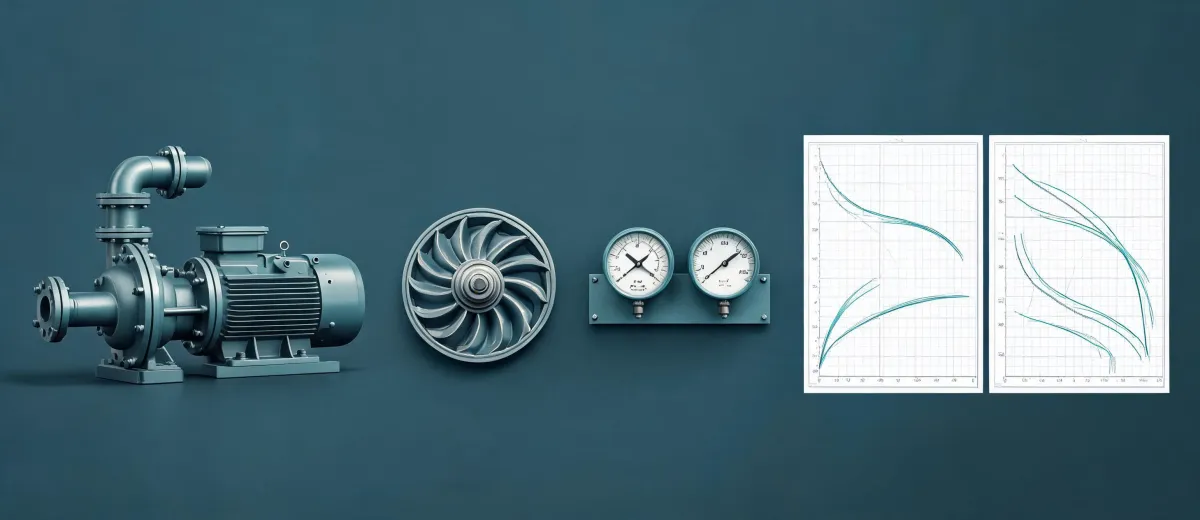
What I should have done: actually look at the Grundfos pump catalogue and the performance curves — not just the flange size and the flow rate on the spec sheet. The Grundfos pump sizing tools (their online selection software and the published catalogue PDFs) give you the full curve, the efficiency range, and the minimum/maximum flow. That data exists for a reason.
For this scenario, my rule now is: spend the extra hour on sizing. It costs nothing compared to the wrong choice. A $1,800 pump that runs 5 years without a seal replacement beats a $1,400 pump that needs service every 14 months.
What does that look like in practice? Pull the system curve. Check the duty point against the pump curve. Confirm that your operating range sits in the 60-85% efficiency band. And if you're comparing two models that both "work" on paper, compare their partial-load performance — because most systems don't run at peak demand all year.
"5 minutes of verification beats 5 days of correction." That's the line I keep taped inside my planning binder. It took me 3 years and about 150 pump-related orders to really believe it.
Scenario B: Replacement Parts and Maintenance Items
This is where you already own the equipment. Maybe it's a circulator that's been in service for years, a compressor in the back of the shop, or a spare pump on the shelf that hasn't moved since 2021.
The decision here isn't what to buy — it's when to buy it. Do you wait for the failure, or do you replace on a schedule?
The most frustrating part of maintenance procurement: the numbers never line up cleanly. You'd think a $35 air compressor capacitor is a no-brainer to keep in stock, but when you've got 14 compressors across different job sites and the failure rate is unpredictable, it's not obvious which ones to pre-buy for.
So here's the framework I use now. For each piece of equipment, I ask one question: what does one hour of downtime cost?
If the answer is "nothing, it's backup equipment" — wait for the failure. Buy the part when you need it. Keep a cheap universal spare if you want, but don't overthink it.
If the answer is "$400+ because a crew of three is standing around" — you need the part before it fails. An air compressor capacitor is a good example. It's a $20-40 part, it takes 10 minutes to swap, and it almost always fails at the worst possible moment (usually Monday morning, in my experience).
But here's the twist I didn't expect: the spare doesn't always need to be the OEM part. For some components, a compatible aftermarket replacement works identically and costs 40% less. For others — especially anything that touches pump hydraulics or sealed motor assemblies — you should stick with the manufacturer's part. The line isn't obvious, so I keep a simple rule now: electrical components, universal. Mechanical components directly inside the pump or compressor head, OEM.
One more thing on this scenario: don't let your spare parts inventory become a graveyard. I audited our stock in Q2 2024 and found $6,800 worth of parts we'd never used for equipment we'd already sold or replaced. That's money sitting on a shelf. Track what you buy, note the equipment it's for, and review annually.
Scenario C: Shop Tools and Consumables
This one covers the stuff you use every day — hand tools, air tools, lubricants, fittings, and all the odds and ends that keep the shop running.
People assume the lowest unit price is the best deal for shop supplies. What they don't see is the multiplier effect: a cheap tool that gets replaced three times a year costs more than the good one that lasts six years — and the downtime from a tool giving out mid-job is rarely factored in.
But I'd argue the opposite is also true: not every tool needs to be premium. You don't need a $90 set of pliers for every apprentice's toolbox.
Take the Knipex Cobra XS 4-inch pliers — I've seen these get reviewed as "the last small pliers you'll ever need." And honestly, they're excellent. The jaw grip is genuinely better than anything else I've used at that size, and the push-button adjustment works smoothly even after months of daily use. But at roughly $45-50 per pair (as of early 2025), they're not for everyone. If you've got a crew of 6 and everyone wants a pair, that's $300 right there — more than most shops budget for pliers in a year.
My approach: buy one or two pairs of the good ones for the leads, and buy decent mid-range pliers ($20-25) for everyone else. The work gets done, the budget stays intact, and when someone proves they won't lose them, you upgrade.
Air tool oil in an air compressor — this one comes up more than you'd think. Quick answer: no, you shouldn't use air tool oil in your compressor crankcase. They're formulated for different purposes. Air tool oil is designed to lubricate pneumatic tool motors and is usually introduced through the air line. Compressor crankcase oil handles higher temperatures and different load conditions. Using the wrong one can varnish the valves or degrade the seals.
If you've got a small oil-free compressor, neither one applies — they don't have a crankcase to fill. But if you're topping off a belt-drive compressor, use the manufacturer-specified compressor oil or a compatible ISO-grade substitute. Not the bottle that says "air tool oil" on the front.
How to Figure Out Which Scenario You're In
Here's the simplest test I can give you:
- Is this a new spec or a replacement? If new, you're in Scenario A. Spend the time on sizing and selection. If replacement, keep reading.
- What's the cost of failure? If a failure means downtime on a critical system, you're in Scenario B. Pre-buy the part. If failure is inconvenient but not costly, wait.
- Is this a consumable or a durable? Consumables (oil, fittings, blades) — buy in bulk if you have storage, buy as-needed if you don't. Durables (tools, instruments) — apply the multiplier test: how many times will you replace the cheap version vs. buying the good one once?
None of this is glamorous. It's just the math I wish someone had handed me 6 years ago instead of letting me learn it one blown budget quarter at a time.
If there's one thread connecting all three scenarios, it's this: the cheapest decision and the most expensive decision are both usually wrong. The right answer is situational, and the only way to find it is to ask the right questions before you place the order.