Most pump and tool buying mistakes come down to three things: wrong spec, wrong source, or wrong part. Get those three right and you skip the expensive part. I learned this the hard way — about $4,800 in avoidable mistakes across roughly seven years of procurement. Here's every one of them.
Start with the most expensive. In March 2022, I sized a centrifugal pump for a commercial HVAC retrofit. I used a spec sheet left over from a previous project — a different building, different load, different everything. We ended up installing a pump whose flow and head curves didn't match the actual system. It ran fine on its own. The moment the second zone kicked on, flow dropped off. That round alone cost $1,900 plus 11 days of delay.
The deeper issue: I was treating pump sizing as a judgment call. It's a math problem.
How to Size a Centrifugal Pump (Without Guessing)
If you've searched how to size a centrifugal pump, you've probably seen the same answer — flow and head, look at the curve. True, but not helpful at 6 am on a job site. You need two numbers before you can pick anything.
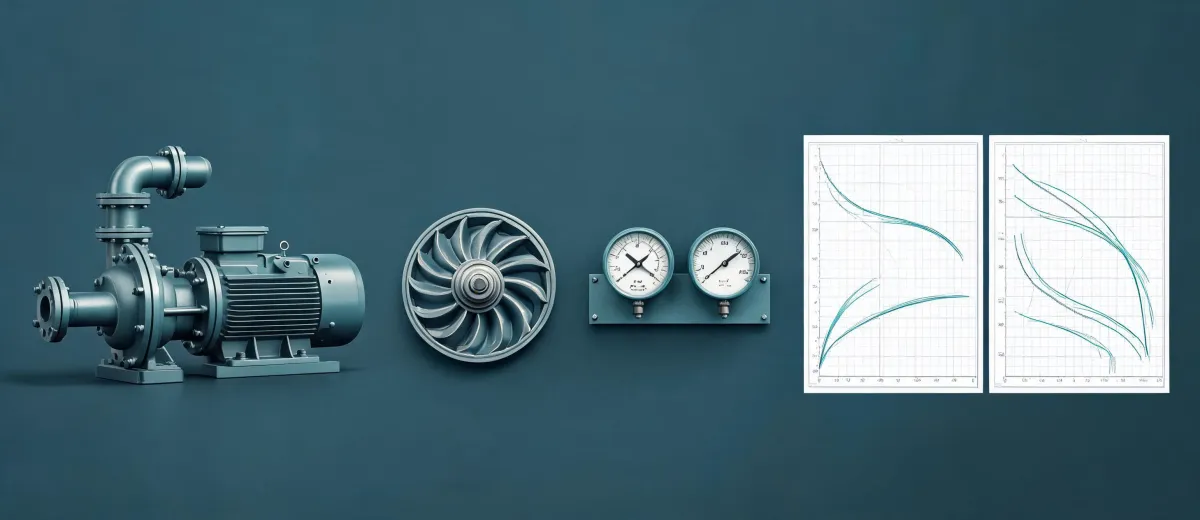
Flow (GPM or m³/h) and total head (feet or meters). Total head has to include pipe friction, elbows, valves, and elevation change. Miss one and the pump is wrong. The method that finally worked for me: plot the required point on the chart, then trace back to the pump curve that crosses it.
Another thing I got wrong the first time — the operating range matters more than the peak efficiency point. If the curve is too steep, a small change in your system pushes the pump out of range. If it's oversized, it runs inefficiently forever.
Ask yourself: is the pump going to modulate between high and low load, or run at one fixed condition? If it's the former, you may need a different model — or a different type entirely.
Grundfos Pump Gaskets — The Quiet Failure Point
A gasket feels minor. It isn't. Gaskets are exactly the kind of part that fails quietly and takes weeks to diagnose. In 2021, I bought compatible Grundfos pump gaskets from a third-party seller because I needed them fast. Cheaper, sure. Within a few weeks, two of the pumps started weeping. Not full leaks — just the kind of slow seep you ignore until the insulation is soaked.
We ended up pulling both pumps, redoing the gaskets, and burning half a day. Lesson: buy Grundfos pump gaskets only from a source you can trace. An authorized dealer, the manufacturer's official channel, or a parts supplier you've actually worked with and who can show documentation.
Here's something vendors won't tell you: some third-party sellers move old stock as new. Gasket material ages. You won't see it at install — you'll see it when the leak starts.
Where to Buy Grundfos Pumps (And What It Costs to Get It Wrong)
If you're wondering where to buy Grundfos pumps, the riskiest move is buying from whoever happens to be cheapest. General retailers do carry Grundfos products, but an authorized dealer gives you something a general channel can't: application-specific sizing help, correct model matching, and a purchase trail that won't hurt you in a warranty claim.
This isn't abstract. I've watched contractors go through non-authorized channels, then get stuck in a claim that went nowhere. The right question isn't can I get a discount — it's can I get a resolution if something goes wrong.
The "any dealer is fine" thinking comes from an era before fast logistics and online traceability. Today, the difference between sources isn't availability — it's the support behind it.
The Cheap Electrician Tool Set (80014) Trap
In 2020, I bought an electrician tool set — the standard configuration, model 80014. Price was half of the name-brand option. What happened? The insulated pliers' grips cracked by month four. The screwdriver tips were too soft and stripped the second time I actually leaned on them.
They didn't fail outright. They failed at the worst possible moment, halfway through an install. Fixing that cost more than the better set would have.
What to check before buying a cheap electrician tool set: are the cutting edges heat-treated? Does the insulation carry a voltage rating and test mark? Are the grips hard plastic or actually rated for grip-under-load?
Not saying the expensive option is always right. But some tools can't be cheapened safely.
6-Gallon 150 PSI Air Compressor — The Rating That Fools You
A 6-gallon 150 PSI air compressor is a workshop staple for good reason — portable, adequate pressure, reasonable price. But the 150 PSI number is misleading.
You don't use tank pressure. You use pressure at the tool. Work backwards: how many CFM does each tool need at 90 PSI? If a sander or spray gun calls for 4 CFM and the compressor's pump can't deliver that, tank pressure won't save you. The motor cycles constantly. I've seen people buy this exact spec and discover it can't run their tools — then buy again, at double the cost.
Tank size tells you how long you can run. Pump CFM tells you how fast you recover. Pressure rating tells you the ceiling. Don't buy on the 150 PSI badge alone.
Where This Advice Doesn't Apply
To be fair — this whole framing works best when you're a contractor or running a shop where downtime has a real cost. If you're doing occasional weekend work, buying the cheapest thing that works may genuinely be the right call.
And don't overcorrect. I've been guilty of that too — buying oversized pumps and over-spec'd tools for systems I'd never push to their limit. That's just a different kind of waste. Get the requirement right, then buy to match it.
There's something satisfying about a system that just runs on the first start. No leaks. No callbacks. No phone ringing because the pressure dropped when the second zone came on. When you get it right, nobody notices — which, honestly, is the whole point. Measure first, then buy. Applies to pumps, gaskets, tools, and just about everything else in a procurement list.