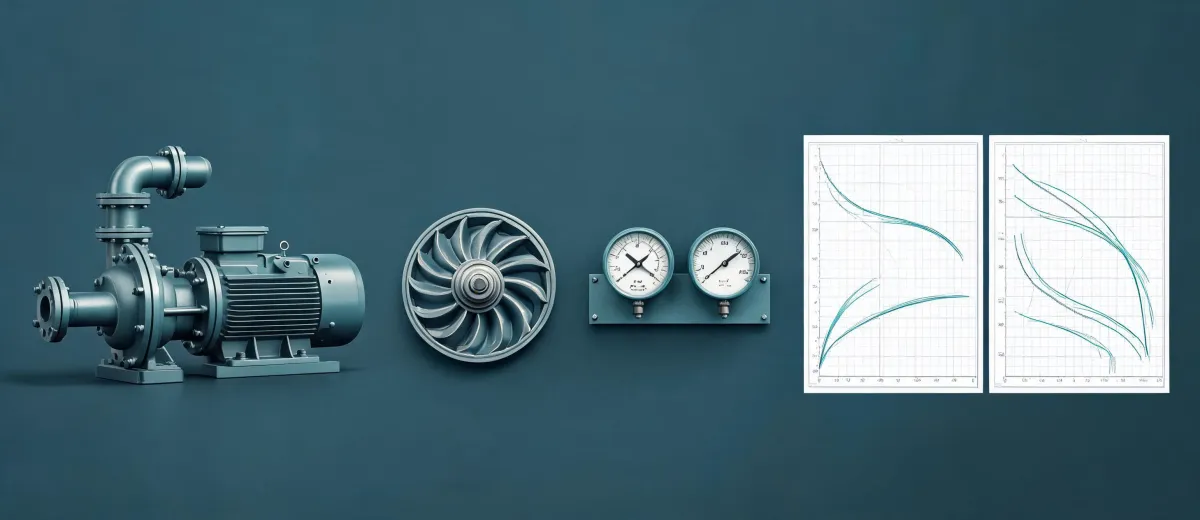
The lowest quote on a pump is rarely the lowest total cost. In six years of managing a roughly $380,000 annual MRO purchasing budget, I've found that the real savings come from checking the exact part number and the mounting data before you order—not from squeezing a discount out of a distributor. Take the Grundfos UPS circulator pump 96402708: the part number looks complete, but if you don't verify voltage, port size, and speed setting, you're gambling with return shipping and downtime.
That's the conclusion I keep coming back to. I'm a procurement manager at a 58-person facilities maintenance company, and I've managed our building-services purchasing budget for six years. I've negotiated with 40+ vendors and logged every order in our cost-tracking system. When I audited our 2023 spending, I found that 21% of pump-related budget overruns came from expedited shipping after ordering the wrong revision—not from the pump price itself.
To be clear, I'm not a pump engineer. If a building needs a custom hydronic design, I call an engineer. My job is to make sure the right product gets ordered at a cost we can defend. That division of work matters: a vendor who says "this needs a designer, not a sales call" is more trustworthy than one who says "we can build it all."
What actually changes the total cost on a pump order
I've never fully understood why some distributors list the same Grundfos model number with different photos and suffix codes. My best guess is regional revisions. So we always pull the technical spec before we buy. If you're searching for a Grundfos NBG pump, the datasheet is your friend. The NBG line is common in our retrofit work; from a buyer's side, its main advantage is that seal kits and spare parts are usually stocked locally.
It's tempting to think you can compare unit prices and call it a day. But identical specs from different vendors can result in wildly different outcomes because of freight, warranty handling, and the person who answers the phone. We once chose a cheaper supplier for a UPS circulator because the quote was $140 lower. The shipment came without a flange gasket set, and we had to pay overnight freight for the missing parts. The "saving" disappeared.
Spare parts are another hidden cost. Our old policy was to buy the cheapest repair kit on the list. Then I ran a comparison of what each kit actually included, and the mid-priced kit from one distributor included all the gaskets, not just the impeller ring. In Q2 2024, switching vendors on repair kits saved us about $8,400 a year—roughly 17% of that category's budget.
And another thing: if a distributor tells you a pump is "maintenance-free," I want to see that in writing. Per FTC advertising guidelines (ftc.gov/business-guidance/advertising-marketing), claims have to be truthful and substantiated. From a purchasing angle, I translate "maintenance-free" as "less maintenance," not "zero maintenance." A pump that's sealed may still need a capacitor or a control board replaced eventually.
The pump curve is another piece of paper I don't skip. Grundfos publishes performance data for every pump family, and for the Grundfos NBG pump, the curve will tell you if the pump operates in the right part of its range. We once installed a circulator that was oversized for the loop. It ran fine, but it consumed more power than necessary every month. The supplier's quote was fine; the application was wrong. Don't underestimate the cost of a wrong operating point.
A related point: return policy matters more than most people think. We've paid restocking fees on pumps that had to go back because the flange type didn't match the existing piping. Some vendors charge a 20% restocking fee plus freight. That's why I always ask for the product's technical data and not just a photo. The same photo can be used for three different models.
Mounting hardware and tool storage: the part people skip
The most expensive line item in one pump job wasn't the pump. It was a failed anchor bolt and the concrete redo. I learned that from a contractor who used the wrong anchor for a baseplate. Now, before any pump mounting job, I pull the Kwik Bolt 3 technical data sheet. It lists the correct bit size, minimum embedment, edge distance, and torque. It sounds like a textbook detail, but it's the difference between a base that stays put and one that gets ripped out.
Where to find premium tool storage accessories? This is not a random question—tool storage is part of every MRO project. We've found better results with authorized tool dealers than with the big-box bargain aisle. The difference isn't the paint job; it's the drawer slides and whether you can still buy replacement casters in five years. We bought one heavier-duty cabinet after replacing two cheap ones, and it's held up for years. That's a TCO decision, not a vanity brand decision. The return on a good cabinet comes from not having to re-buy the cheap one.
The same logic applies to gear questions like "where is chainsaws made." A mechanic asked me that while we were updating the shop inventory. I get why people care about country of origin, but the more practical question is whether the local dealer stocks parts. A saw from any country is useless when you can't get a chain and bar quickly. Same with pumps: availability is part of the total cost. For a Grundfos pump, I'd rather have a local distributor with a replacement pump on the shelf than a slightly cheaper online order with no callback number.
How I'd set up the buying process
If I had to set up a purchasing system today, I'd do three things: log every order as soon as it's placed, save the datasheet with the part number, and get a second quote on anything over a few hundred dollars. Our procurement policy now requires three quotes on major pump orders because one time a single-source quote came in 17% higher than a distributor we didn't know existed. That's not an attack on the first vendor; they were fine. But without a comparison, we'd have paid the higher price.
We've handled maybe 180 pump orders in that system—maybe 160, I'd have to check the spreadsheet—but the pattern is clear. The right part, with the right data, from a vendor who backs it up, is almost always the low-TCO option. I built a simple cost calculator after getting burned on hidden fees twice. It includes the quoted price, estimated freight, restocking risk, lead time, and the cost of lost water service if the pump fails. It's not a sophisticated tool, but it catches the "cheap" quote that isn't cheap.
A caveat: this approach is for standard pump replacements and MRO purchases. If you're building a new plant or designing a complex pressure-boosting system, don't take my shortcut. That's a job for an engineer. I'd rather say "this is outside my lane" than guess and cost you money later.